| Fact: Modern hunting crossbows are of the compound or recurve archery bow design that shoot arrows that are the same as any hand-held bow's arrow. Recurve Crossbows Description:
Recurve Crossbows: Limbs, History, Noise, Accuracy, Power, Models.
Recurve crossbows are really quite simple in design. They consist of a stock, a simple prod, a metal, wood or fiberglas laminate limb which bends to store energy and is released with a trigger device releasing this stored energy to launch the arrow or bolt. 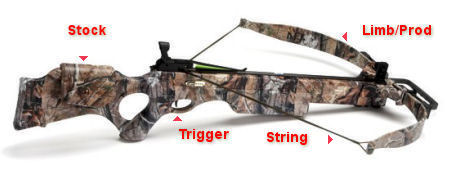 Recurve Crossbows Limbs:
Recurve crossbows are a bow that has tips curving away from the archer. The recurve crossbow's bent limbs have a longer draw length than an equivalent straight-limbed crossbow, giving more acceleration to the bolt or arrow. Recurve Crossbows History:
Recurve crossbows have been around for thousands of years, they date as far back as 341 BC. Since that time they've evolved substantially in design, have become lighter in weight, and are more accurate as well. Recurve Crossbows Noise:
An inherit feature of recurve crossbows is; they are somewhat quieter when fired as opposed to a much faster compound crossbow. Recurve Crossbows Cocking Accuracy:
Cocking any crossbow off center is the # 1 cause of accuracy problems, and recurve crossbows are the most sensitive to this issue. The recurve crossbows limbs have no way to adjust to uneven pressure when cocking. Recurve Crossbows Power:
Two factors determine the amount of energy recurve crossbows can hold.
1. Its draw weight, which is the amount of force required to draw the recurve bow. A recurve crossbow's draw weight increases the farther back you pull the string until it reaches its peak weight, with no let off.
2. Its draw length is the distance between the crossbowstring's position at rest and its position when drawn. The total amount of energy that a recurve crossbow can hold is approximately equal to its draw weight, times its draw length, divided by two.
In other words, a recurve crossbow's overall power depends on how hard it is for you to pull the string and how far back you are able to pull it.
Crossbow manufacturers express this power in terms of:
1. The crossbow's peak draw weight.
2. The crossbow's energy, measured in foot-pounds.
3. The crossbow arrow's velocity, measured in feet per second. 2010 Recurve Crossbow Models, Overviews & Specifications; Recurve Crossbows |






